AI Sales Calls: The Ultimate Guide to AI Sales Assistants and Automation for Business Growth
Discover how AI sales calls and AI sales assistants automate lead qualification, cold calling, and appointment booking to boost conversions and sales efficiency.

Kennedy Asuru
Jan 7, 2026
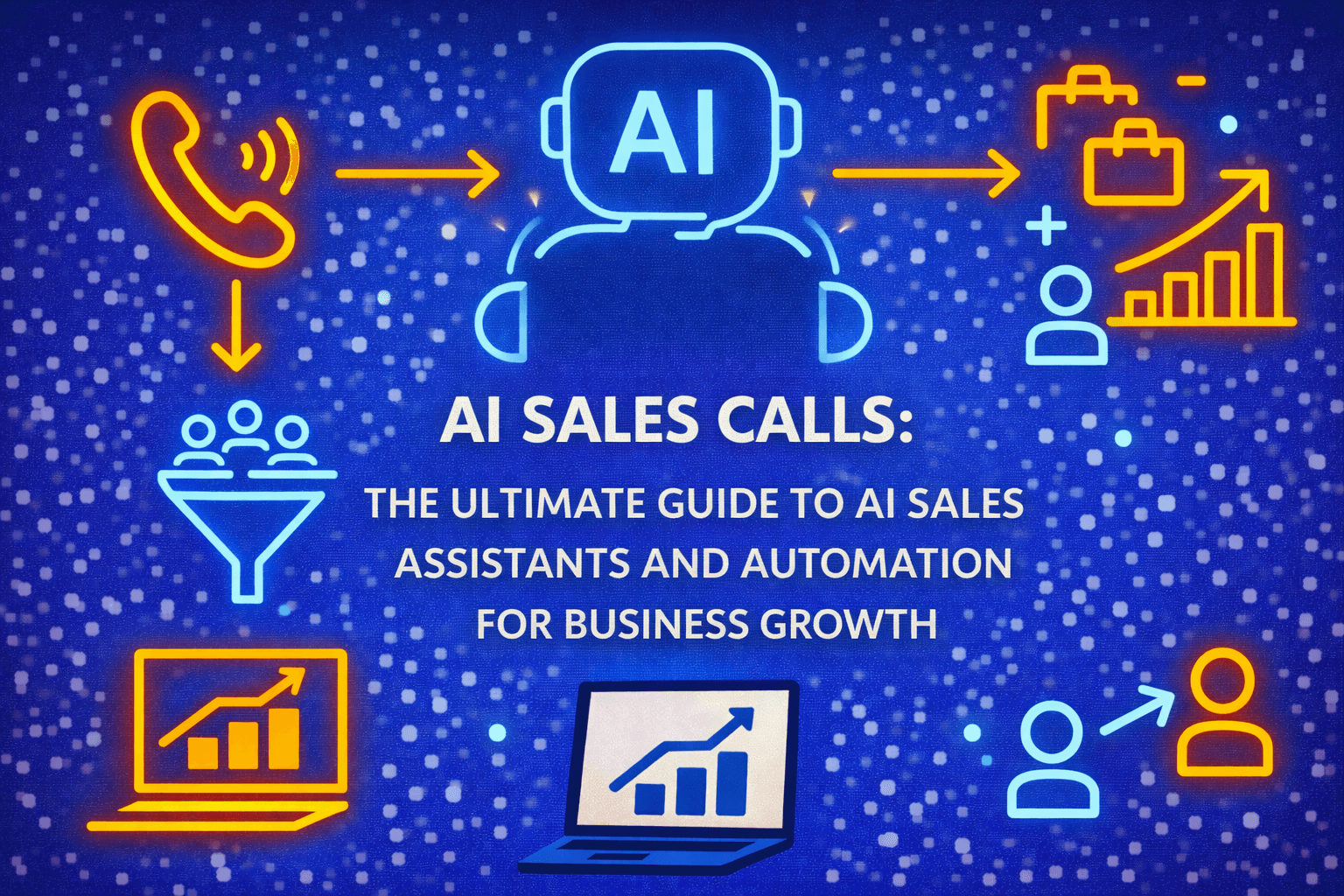

In the rapidly evolving landscape of sales, AI sales calls have emerged as a transformative force, reshaping how businesses engage with prospects and customers. This comprehensive guide delves into the mechanics of AI sales calls, the role of AI sales assistants, and the myriad benefits they offer for business growth. Readers will learn how AI technology enhances sales efficiency, improves lead qualification, and ultimately drives higher conversion rates. As companies strive to optimize their sales processes, understanding the intricacies of AI sales calls becomes essential.
Many businesses face challenges in managing inbound and outbound sales calls effectively, often leading to missed opportunities and inefficient workflows. AI sales assistants provide a solution by automating routine tasks, qualifying leads, and managing follow-ups, allowing sales teams to focus on closing deals. This article will explore the workings of AI sales calls, the best practices for implementation, and the future of AI in sales, providing a roadmap for businesses looking to leverage this technology.
What Are AI Sales Calls and How Do AI Sales Assistants Work?
AI sales calls refer to the use of artificial intelligence technology to conduct sales conversations, either through automated systems or AI-driven sales assistants. These systems utilize advanced algorithms and machine learning to engage with prospects, qualify leads, and facilitate sales processes. The primary benefit of AI sales calls is their ability to enhance efficiency by automating repetitive tasks, allowing human sales representatives to concentrate on more complex interactions.
AI sales assistants operate by leveraging conversational AI, which enables them to understand and respond to customer inquiries in a natural, human-like manner. This technology utilizes voice recognition and natural language processing to interpret customer intent and provide relevant responses. As a result, businesses can expect improved customer engagement and satisfaction, potentially leading to higher conversion rates.
How Does Conversational AI Enable Effective Sales Calls?

Conversational AI plays a crucial role in enhancing the effectiveness of sales calls by enabling real-time interactions that mimic human conversation. This technology allows AI sales assistants to engage with prospects in a personalized manner, addressing their specific needs and concerns. For instance, an AI sales assistant can analyze customer data to tailor its responses, making the conversation more relevant and engaging.
The design and implementation of such agents are critical for optimizing customer interactions, as highlighted by recent research.
Conversational AI Agents: Designing for Customer Service
Conversational AI agents are fundamentally changing how firms are delivering service to their customers. The rapid advancement of technology and ready tools means that deploying a conversational AI agent has become far simpler than ever imagined. Drawing on the theoretical notions of customer experience (CX) management, personalization, and AI in service, we develop a framework to design conversational AI agents.
Designing a conversational AI agent: Framework combining customer experience management, personalization, and AI in service techniques, J Blümel, 2023
Moreover, conversational AI can handle multiple calls simultaneously, significantly increasing the volume of interactions a business can manage. This scalability is particularly beneficial for companies looking to expand their outreach without compromising the quality of customer interactions. By utilizing conversational AI, businesses can streamline their sales processes and improve overall efficiency.
How Does AI Sales Automation Improve Lead Qualification and Conversion Rates?
AI sales automation enhances lead qualification by analyzing vast amounts of data to identify high-potential prospects. This process involves evaluating customer interactions, behaviors, and preferences to determine which leads are most likely to convert. By automating lead qualification, businesses can focus their efforts on prospects that are more likely to result in sales, thereby increasing conversion rates.
Further emphasizing this point, studies demonstrate how advanced algorithms can significantly refine lead scoring and qualification processes.
AI for Sales Efficiency: Lead Scoring & Qualification
This research paper explores the application of artificial intelligence, specifically Random Forest and Logistic Regression algorithms, to enhance sales efficiency through improved lead scoring and qualification. In an era where data-driven decision-making is crucial, traditional sales processes often lack the precision necessary to maximize conversion rates, leading to inefficiencies and resource wastage. By integrating machine learning techniques, businesses can better prioritize leads, optimize sales strategies, and ultimately increase revenue.
Enhancing Sales Efficiency with AI: Implementing Random Forest and Logistic Regression Algorithms for Lead Scoring and Qualification, A Sharma, 2022
The integration of AI in lead qualification also reduces the time spent on manual processes, allowing sales teams to allocate their resources more effectively. With AI handling initial assessments, sales representatives can dedicate more time to nurturing relationships with qualified leads, ultimately leading to higher sales success.
What Are the Benefits of AI-Powered Lead Qualification?
Increased Efficiency: Automating the lead qualification process saves time and resources, allowing sales teams to focus on high-value activities.
Higher Conversion Rates: By identifying and prioritizing leads with the highest potential, businesses can improve their chances of closing deals.
Cost Savings: Reducing the time spent on unqualified leads translates to lower operational costs and improved return on investment.
How Does AI Handle Objections During Sales Calls?
AI sales assistants are equipped with techniques to manage objections effectively during sales calls. By utilizing data-driven insights and pre-programmed responses, AI can address common concerns raised by prospects. For example, if a potential customer expresses hesitation about pricing, the AI can provide information on the value and ROI of the product, helping to alleviate concerns.
Additionally, AI can learn from past interactions to refine its objection-handling strategies continuously. This adaptability ensures that the AI sales assistant becomes more effective over time, potentially leading to improved customer satisfaction and higher conversion rates.
What Are the Best Practices for AI Cold Calling and Outbound Sales?
Implementing AI in cold calling and outbound sales requires a strategic approach to maximize effectiveness. Here are some best practices to consider:
Personalization: Tailor interactions based on customer data to create a more engaging experience.
Data-Driven Insights: Utilize analytics to inform calling strategies and identify the best times to reach prospects.
Continuous Learning: Regularly update AI algorithms based on feedback and performance metrics to enhance effectiveness.
By following these best practices, businesses can ensure that their AI sales assistants are equipped to handle cold calling and outbound sales effectively.
How Can AI Voice Agents Book More Appointments Automatically?
AI voice agents can significantly streamline the appointment booking process by automating scheduling tasks. By integrating with calendars and CRM systems, these agents can identify available time slots and propose them to prospects during calls. This automation reduces the back-and-forth communication typically associated with scheduling, leading to higher appointment booking rates.
This capability aligns with the broader application of AI chatbots as virtual assistants, which are increasingly used to automate tasks like appointment booking.
AI Chatbots: Virtual Assistants for Business Efficiency
Chatbots are programs that mimic human conversation using Artificial Intelligence (AI). It is designed to be the ultimate virtual assistant, entertainment purpose, helping one to complete tasks ranging from answering questions, getting driving directions, turning up the thermostat in a smart home, to playing one’s favorite tunes etc. Chatbot has become more popular in business groups right now as they can reduce customer service cost and handles multiple users at a time.
Voice-bot for Book An Appointment, NM Pathirage, 2023
Moreover, AI voice agents can follow up with prospects who have shown interest but have not yet scheduled an appointment. This proactive approach ensures that potential leads are nurtured effectively, increasing the likelihood of securing meetings.
How Does AI Personalize Cold Calls to Increase Meeting Conversion?
AI personalizes cold calls by leveraging customer data to tailor conversations. This personalization can include referencing previous interactions, understanding customer preferences, and addressing specific pain points. By making the conversation relevant to the prospect, AI can increase the chances of converting cold calls into scheduled meetings.
Additionally, AI can analyze the effectiveness of different personalization strategies, allowing businesses to refine their approaches continuously. This data-driven method ensures that cold calling efforts are optimized for maximum impact.
How Can Businesses Integrate AI Sales Assistants with CRM Systems?

Integrating AI sales assistants with CRM systems is essential for maximizing the benefits of AI in sales processes. This integration allows for seamless data sharing between the AI assistant and the CRM, enabling more informed decision-making and improved customer interactions.
Which CRM Platforms Seamlessly Work with AI Sales Automation?
Salesforce: Offers robust integration capabilities with various AI tools, enhancing sales processes.
HubSpot: Provides built-in AI features that complement its CRM functionalities.
Zoho CRM: Integrates with AI sales assistants to streamline lead management and customer interactions.
What Are the Steps to Implement AI Sales Calls in Existing Sales Pipelines?
Implementing AI sales calls in existing sales pipelines involves several key steps:
Assess Current Processes: Evaluate existing sales workflows to identify areas where AI can add value.
Select AI Tools: Choose AI sales assistants that align with business needs and integrate well with existing systems.
Train Sales Teams: Provide training for sales representatives on how to effectively utilize AI tools in their workflows.
Monitor and Optimize: Continuously track performance metrics and make adjustments to improve effectiveness.
By following these steps, businesses can successfully integrate AI sales calls into their sales pipelines, enhancing overall efficiency and effectiveness.
What Are the Industry-Specific Applications and ROI of AI Sales Calls?
AI sales calls have applications across various industries, each benefiting from the technology in unique ways. Understanding these applications can help businesses identify opportunities for implementation.
How Does AI Sales Automation Benefit Real Estate and Home Services?
In the real estate and home services sectors, AI sales automation can streamline lead generation and customer engagement. For instance, AI can qualify leads based on specific criteria, such as budget and location, ensuring that agents focus on high-potential prospects. Additionally, AI can automate follow-up communications, keeping potential clients engaged throughout the decision-making process.
The ROI from implementing AI in these industries can be substantial, with increased lead conversion rates and reduced operational costs contributing to overall profitability.
What Metrics Demonstrate ROI from AI Sales Assistants?
To measure the ROI from AI sales assistants, businesses should consider the following metrics:
Conversion Rate: The percentage of leads that result in sales.
Cost per Acquisition: The total cost of acquiring a new customer, including marketing and sales expenses.
Sales Cycle Length: The average time it takes to close a deal, which can be reduced through effective AI integration.
By tracking these metrics, businesses can assess the impact of AI sales assistants on their overall sales performance and make informed decisions about future investments.
What Is the Future of AI Sales Calls and Human-AI Collaboration?
The future of AI sales calls is poised for significant growth, with advancements in technology leading to more sophisticated AI sales assistants. As these tools become increasingly capable, the collaboration between human sales representatives and AI will evolve, creating a more efficient sales environment.
How Will AI Transform Sales Teams and Customer Interactions?
AI is set to transform sales teams by automating routine tasks, allowing representatives to focus on building relationships and closing deals. This shift will lead to a more strategic approach to sales, where human representatives can leverage AI insights to enhance their interactions with customers.
Furthermore, AI will enable more personalized customer experiences, as sales assistants can analyze data to tailor conversations and recommendations. This level of personalization is expected to drive higher customer satisfaction and loyalty.
What Are Common Concerns About AI in Sales and How Are They Addressed?
Despite the benefits of AI in sales, some common concerns include data privacy, job displacement, and the potential for reduced human interaction. To address these concerns, businesses must prioritize transparency in their AI practices, ensuring that customer data is handled securely and ethically.
Additionally, companies should emphasize the complementary role of AI in sales, highlighting how it enhances rather than replaces human capabilities. By fostering a collaborative environment, businesses can alleviate fears and encourage acceptance of AI technologies.
AI Sales Assistant Feature | Description | Benefit |
Automated Call Handling | AI manages inbound and outbound calls | Increases efficiency and reduces workload |
Lead Qualification | AI analyzes data to identify high-potential leads | Improves conversion rates and focuses efforts |
Objection Handling | AI provides responses to common objections | Enhances customer satisfaction and trust |
The integration of AI sales assistants into sales processes offers numerous advantages, from improved efficiency to enhanced customer interactions. As businesses continue to adopt these technologies, understanding their applications and benefits will be crucial for success in the competitive sales landscape.